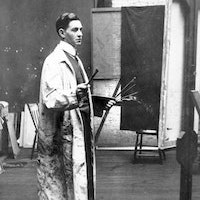
Frederick Nicholas Loveroff
1894 - 1959 RCA, OSA
Frederick Nicholas Loveroff Biography
1894 - 1959 RCA, OSA
Frederick Nicholas Loveroff was born Frederick Nicholas Postnikoff in Tbilisi, Georgia (formerly Tiflis, Russia) in 1894. After his mother's death, he immigrated with his father and six siblings to Saskatchewan in 1900 as part of the Doukhobor movement seeking religious freedom. His artistic talent emerged during his education at a Quaker school in Pennsylvania (1903-1906) and was further developed during long winter nights on the Canadian prairies, where he taught himself watercolor painting.
In 1913, Loveroff moved to Toronto, adopting his maternal family name, and enrolled at the Central Ontario School of Art. There he studied until 1917 under notable instructors including George Reid, William Cruikshank, J.E.H. MacDonald, and J.W. Beatty, whose influence is particularly evident in Loveroff's work. His talent was quickly recognized—he exhibited with the Royal Canadian Academy as early as 1915, was elected an Associate member in 1920, and became a member of the Ontario Society of Artists in 1921.
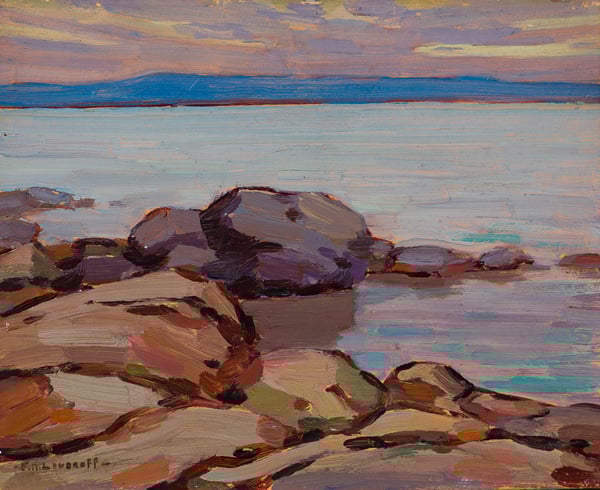
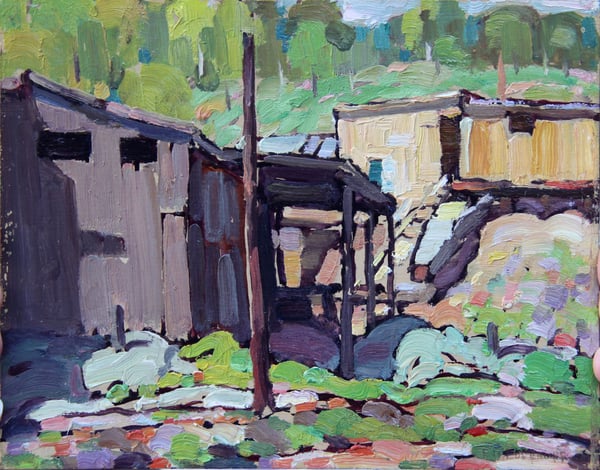
Loveroff gained recognition for his perceptive landscapes featuring vibrant Impressionist coloring and masterful depictions of light effects, particularly in winter scenes. A significant achievement was the acquisition of his painting "Snow on the Hillside" by the Leicester City Art Gallery in England in 1924. His work was also included in exhibitions at the Imperial Gallery of Art in London and the Musée du Jeu de Paume in Paris. Loveroff's painting method involved light-colored underpainting with careful orchestration of color intensity, creating works known for their crispness and strength.
The Great Depression severely impacted Loveroff's career. Unable to sell his work for what he considered fair prices, he stored his remaining paintings in an attic and relocated to California in 1931 with his wife May. He returned to farming and working at a seed company, apparently never painting again. Loveroff died in Redwood, California in 1959 at age 66, leaving behind a relatively small but highly regarded body of work spanning only about 16 years. His paintings can be found in the collections of the National Gallery of Canada, the Art Gallery of Ontario, the University of Toronto Hart House, and several other institutions.