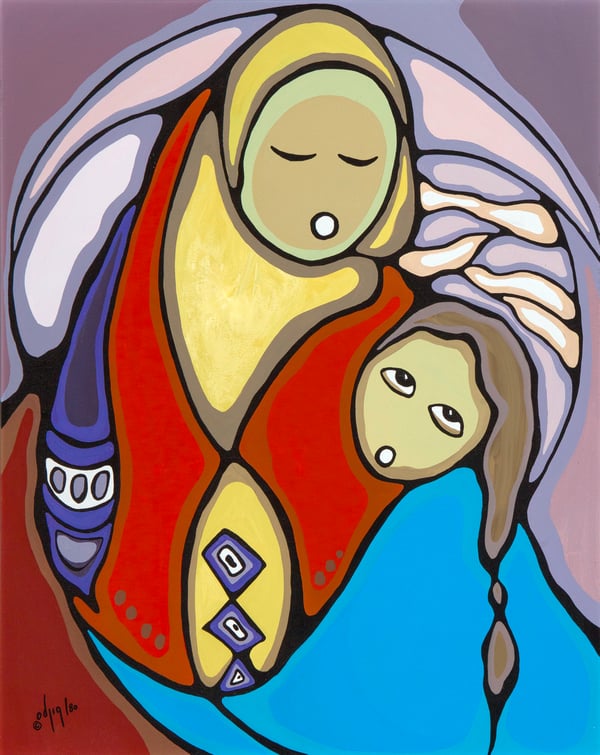
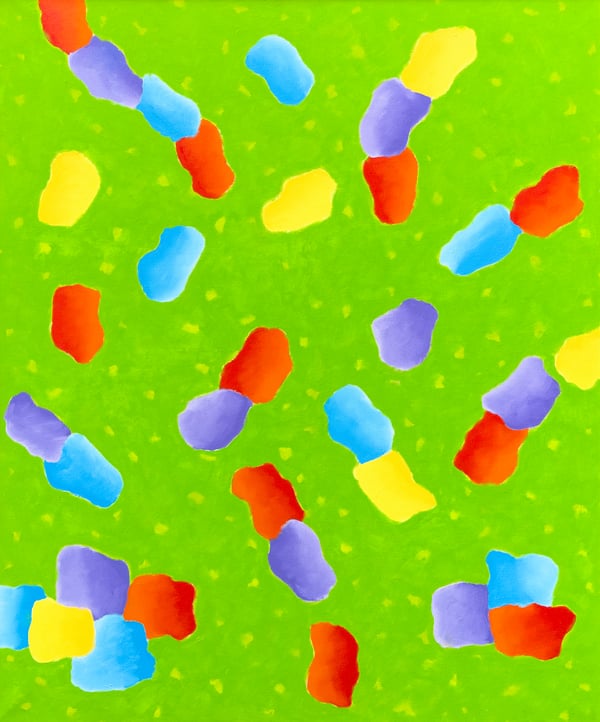
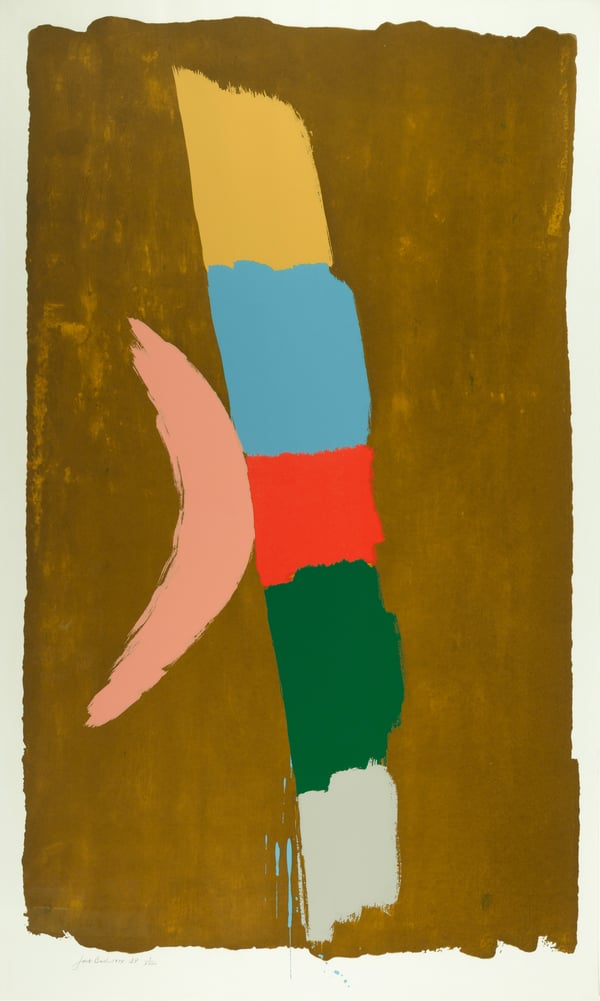
Untitled 'Magenta' by Marian Dale Scott

Untitled 'Magenta'
Marian Dale Scottcirca 1992 Acrylic
24 x 20
Please inquire regarding price.
Marian Dale Scott
RCA1906 - 1993
Click here for details
Marian Dale was born into a well-to-do anglophone Montreal family in 1906. Recent immigrants to Canada, the Dales were part of that social milieu which sought to uphold the values and customs of Victorian England. A published author, Marian’s mother, May Dale encouraged all her children to explore their creative gifts. At an early age Marian displayed a talent for painting and she was soon enrolled at the Art Association of Montreal (AAM, later known the Montreal Museum of Fine Art). She was only eleven at the time.
While she derived great pleasure from painting, later in life she recalled her sense of disappointment with the formal art training of her youth. Beginning students began by drawing simple geometric forms, mastering these before graduating to more interesting subjects. In spite of this rather dull regime for a passionate young artist, she excelled at school and continued at the AAM until 1920. She also studied freehand drawing at the École du conseil des arts et manufactures, and at The Study under Ethel Seath who was member of the Beaver Hall Group of painters.
In her teens, she made a seven-month tour of Europe with a friend, an experience which she found to be life-changing. This adventure made her question the conventional path that society prescribed for the young ladies of her class. In her own words, the life of a debutante, “kills anything that is in you.” Although it was still unusual in the 1920s for women to pursue a profession, Marian was ambitious to become a professional artist. She was cognizant of her debt to some of the more established female artists from whom she was receiving instruction. In her diaries, she observed that, “…many of the women … were working toward a wider world (than had been expected of them). Prudence Heward, Anne Savage, Sarah, Lilias Newton, all tried for new horizons.” Like her mentors, Marian was determined to choose her own path, which was to paint. She continued her art studies at the École de Beaux-arts de Montréal in the fall of 1923, completing the three year course.
While attending the École de Beaux-arts de Montréal, Marian met her future husband, Frank Scott, a gifted McGill law student and future founder of the League for Social Reconstruction and the Cooperative Commonwealth Federation (the CCF Party). He had progressive ideas and was dedicated to the improvement of social and cultural life in Canada. He strongly believed that women were autonomous beings and although he was seven years her senior, they saw eye-to-eye on many social issues. Marian, herself had some radical inclinations by the standards of the day. He also had a love of art and recognized and admired her unique abilities. As they saw more and more of each other, their friendship matured into love, but Marian had long-planned to attend the Slade School of Art in London carry on with her art education.
The young couple were unofficially engaged by the time Marian left for London. The Slade School operated on an academic teaching model, though it was more progressive than the Royal Academy schools. The students drew from models and visited London’s many galleries and museums. She wrote to Frank: “The Slade is really the most interesting and amusing place, and drawing grows in fascination.” However, under pressure from Frank, she cut her studies short and returned after only one year and they were married in 1928.
On her return from England, she resumed painting seriously. In 1929, she exhibited work both in the AAM and the Royal Canadian Academy of Arts exhibitions. She continued to exhibit regularly at the AAM, and the Ontario Society of Artists. In her early work, she concentrated on landscapes with curving lines and flowing movement, influenced by the landscape painting of Lawren Harris. In 1934, finding inspiration in the painting of Georgia O’keeffe, she embarked on an experimental series of paintings with floral motifs. By 1935, she turned her back on landscape painting entirely.
An analytical artist, she aspired to bring logic and order to her painting. Rather than basing her work on pure emotion, she hoped that her art could, in a symbolic way, “bring order to a world of Chaos.” With the Depression making a misery of the lives of many around her, she felt her art should address life’s realities. She recognized the dichotomy that this posed, that while the artist was a reflection of society, she was, at the same time, a prophet. Alternatively, she was also attracted to the idea of “letting the painting paint itself,” to access the subconscious for hidden meaning. She believed that painting was the product of both the conscious and the unconscious minds.
In 1936, the physician and philanthropist, Norman Bethune, arrived in Montreal. Aside from his well-known social activism, he was also an amateur artist. Working under the premise that creativity through art helps individuals reach their potential, he founded the Children’s Creative Art Centre in his apartment in Beaver Hall Square. This was a concrete example of art helping to meet real social needs, a concept advocated by Marian Scott. She volunteered at the art centre and became close friends with Bethune. When he left for Spain to assist civilians affected by the civil war, Marian’s friends, Fritz Brandtner and his wife took over the apartment and school. With Marian’s help, they continued to run the Centre until 1950.
Since the early thirties, Group of Seven founder, Arthur Lismer had been running a similar children’s art program in Toronto. In addition to the social benefits of such endeavors, there were aesthetic ramifications as well. As prominent artists mounted exhibitions of children’s art, the freedom with which children express themselves came to be seen by many as a model for all artists. A 1938 exhibition of works from the Children’s Creative Art Centre was reviewed in La Presse. The article was titled “Children – Those Young Moderns,” indicating an awareness of the connection between children’s art and the contemporary art of the day. Children’s art, primitive art, and folk art were all genres which Marian Dale Scott looked to for inspiration.
Marian’s art was evolving to reflect her sympathy with many social causes, including the plight of Canadian workers downtrodden by years of Depression hardships. Her unsentimental style of painting leaned toward abstraction as she explored subject matter which included workers, industry and cityscapes in an increasingly stylized manner. She looked for a balance between content and abstraction. She consciously chose impersonal themes, stating: “I will leave landscape, old houses, portraits, snowscenes, [and] picturesque markets to others”. In so doing, the Montreal art critic, Graham McInnis asserted that she had sacrificed her “femininity!”
Marian’s rebellion against “academic” painting was stimulated by her friendships and association with like-minded artists. In 1939, she was involved in the formation of Montreal’s Contemporary Arts Society (CAS). The founders included her close friends, Fritz Brandtner, John Lyman and Jori Smith. The organization was formed to promote public awareness of modern art and to foster the development of progressive art forms. The group eventually grew to include members of the Automatistes, who for decades dominated the modern art scene in Quebec and the rest of Canada.
For some time, Marian had concentrated on urban and industrial themes inspired by Depression hardships, but in 1941 she accepted a mural commission for the Strathcona medical building at McGill University. The subject was scientific research, with an emphasis on endocrinology. She was granted unprecedented access to the labs and microscope equipment at the medical school and went to work researching the theme. This marked a transition to a new phase of her artistic journey towards increased stylization. The resulting mural was met with public approval and critical acclaim. Following the unveiling, an article entitled, “Art as an Inspiration to Science” appeared in Canadian Art magazine.
For the remainder of the 1940s, Marian exhibited regularly with the CAS, the AAM and the Canadian Group of Painters (CGP). She became a member of the CGP in 1947, and was elected Vice-president of the CAS in 1948. She also continued her important work with the Children’s Creative Art Centre. In 1949, Arthur Lismer invited her to join the staff at the Montreal Museum of Art and Design, where she served as instructor of advanced painting from 1949 until 1952.
Marian Scott had friends among the anglophone and francophone arts communities alike. Over the course of the 1950s, she was invited to participate in numerous exhibitions of modern painting organized by the community of French speaking artists. She was included in the 1954 exhibition organized by Marcelle Ferron, entitled “Drawings by 12 Montreal Artists.” In 1956, she exhibited in the “panorama de la pientures montréalaise” along side artists such as Jean-Paul Riopelle and Alfred Pellan. Her art was recognized and accepted among the art vivant circles of the 1950s.
As the decade of the 50s progressed, Marian Scott moved toward an entirely non-objective way of painting which would characterize the last thirty years of her life. Modern painting in Montreal was influenced by two trends during the 1950s, the Automatistes and the Plasticiens. The Automatistes advocated a complete freedom from any form of artistic self-censorship, in favour of an “automatic” drawing/painting technique. The Plasticien movement, emerging in 1955, was a reaction to the Automatistes. It advocated a more orderly approach to painting, stressing colors, lines, and contrast, as is best-illustrated by the works of the European artist, Piet Mondrian. Marian Scott’s pure abstraction of the 60s, 70s and 80s can be classified as neither, but bears the influence of both. She said of her mature works: “As I get older, I wish more and more that my paintings speak for themselves. I like to paint with as much of me as possible.”
Well-known art critic, Robert Ayre proclaimed Scott as a “painter’s painter,” one who never “climbed on the band wagon.” He wrote that she was like a scientist in a laboratory, trying to discover life through colour and form. This was particularly true of her later work. In 1965, she embarked on a series of geometric abstraction, a reflection of Plasticien principles. Each new series of works grew out of what had gone before. Her all-over impasto painting of the late 50s and early 60s had been organized on increasingly geometric lines and led into the geometric/colour field paintings of the mid-to-late 60s. Critics compared these paintings to stained-glass windows, which followed a grid of flowing lines, loosely based on the triangle. The fields of colour were separated not by solid lines but rather by “channels” of unprimed canvas, so while giving a nod to Plasticien issues, they lacked the rigidity of the genre. As she continued to work on this series, the separating lines between the fields of colours gradually disappeared. The all-over grid gave way to an Op-art form of geometric composition, often featuring triangular forms juxtaposed against one another.
Over the course of several years, when she felt that she had reached the potential of her geometric series, she turned another corner. Her next series was reminiscent of her grid paintings, but was based on a lightly-drawn undulating “web” or “net” against a coloured ground. According to the critics, these works were more lyrical than what had gone before. The intertwining lines evoked the web of life, perhaps consisting of the connections between cells.
International Women’s Year of 1974, was an important one for Marian Scott, as her work was included in three important exhibitions. At the National Gallery of Canada her work was selected for an exhibition entitled, “Canadian Painters of the 1930s”. The exhibition highlighted how the modern art movement in Canada had evolved to break through national borders and thrust Canadian art onto the world stage. Quebec artists, and members of the CAS in particular, had played a crucial role in the overall development of modern art in Canada. At the Agnes Etherington Gallery in Kingston, Ontario, Marian Scott was included in the exhibition, “From Women’s Eyes: Women Painters in Canada.” Also marking International Women’s Year, the exhibition, “Quatorze femmes peintres de Québec” took place in Montreal. At 70 years of age, she participated in this exhibition as well. Critics remarked that it was unfortunate that it took the International Women’s Year to show the critical, cultural contributions made by female artists in Canada.
The early 1980s were a very difficult time for the Scotts. Several close friends passed away and Frank’s health began to decline. During the two year period of Frank Scott’s final illness, the artist stopped painting entirely to be at her husband’s side. When he died in January, 1985, she worked through the mourning process by painting. The paintings of this period, while giving a nod to her previous “net” or “web” series, represented for her, an ultimate freedom in her use of paint. Often painting with her hands, as well as a brush, she told friends that she felt as though she was “dancing with paint.” Despite her own frail health, this final series displayed a vital inner energy. When the art historian and author, Esther Trepanier, was contemplating writing Scott’s biography in the late 1980s, she broached the subject of mounting a retrospective exhibition with Marian. Marian Scott firmly declined Trepanier’s suggestion. Promoting her work, bringing her paintings to a wider audience, or achieving greater recognition, had never been important goals to Marian. She made it clear that she wished to dedicate her remaining years and energies to painting.
The artist died at her home in November, 1993. Marian Scott’s career had spanned the evolution of modern art in Canada, from its early awakening to the powerful force it became on the international scene. Without question, she was instrumental in its development. When considering the many directions Marian’s artistic journey had taken, veteran art critic and Scott admirer, Robert Ayre wrote: “Continuous renewal is the phrase that best sums up Marian Scott’s painting. Her way is to take up a theme and explore all possible variations before turning to a new series, moving on while she is still fresh and avoiding vain repetition.” Ayre’s observation is a fitting epitaph to life of Marian Scott. True to her life’s ambition, she continued painting and experimenting until she had, in her estimation, reached her final goal...pure freedom of expression in paint.
Bibliography:
Trépanier, Esther. Marian Dale Scott, Pioneer of Modern Art. Montreal: Musée du Québec, 2000
MacDonald, Colin S. “Scott, Marian 1906-1993.” A Dictionary of Canadian Artists, Volume 8, Part 1. Ottawa: Canadian Paperbacks, 2006