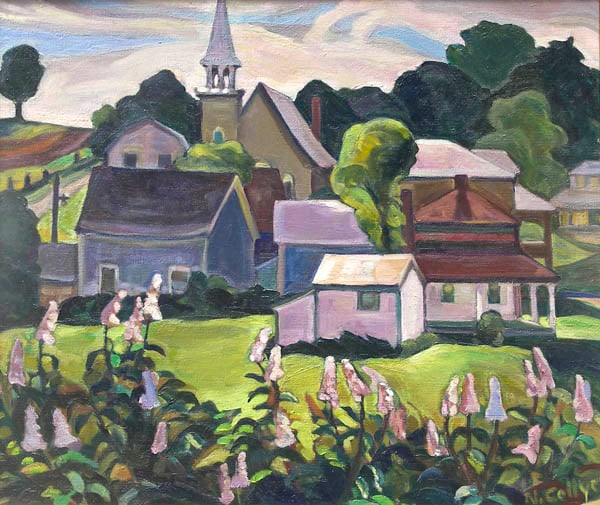
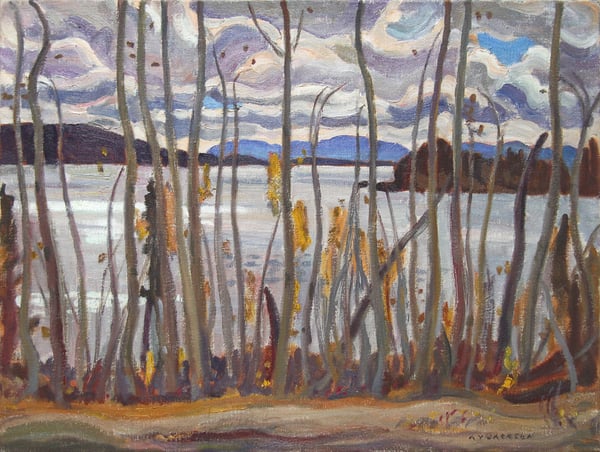
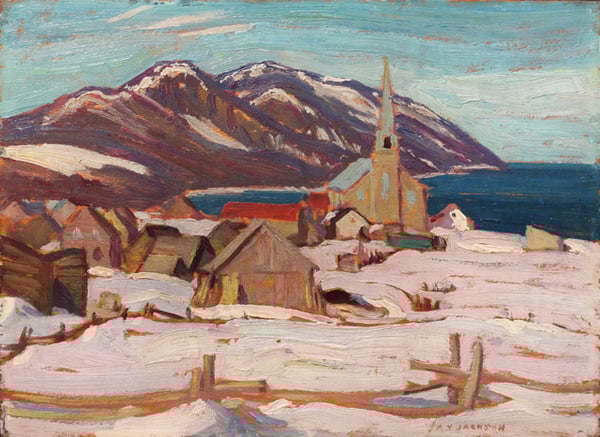
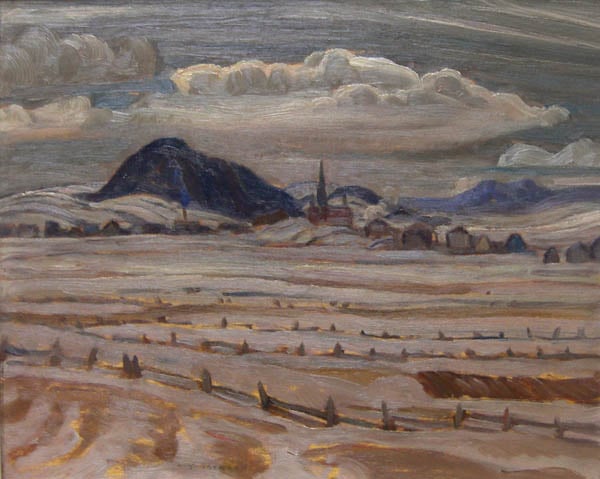
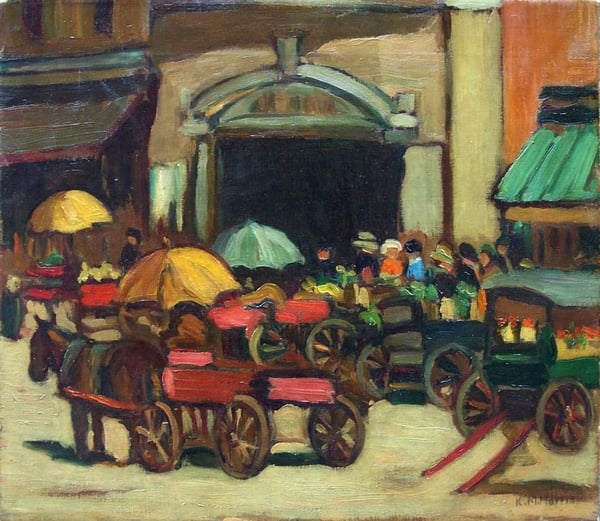
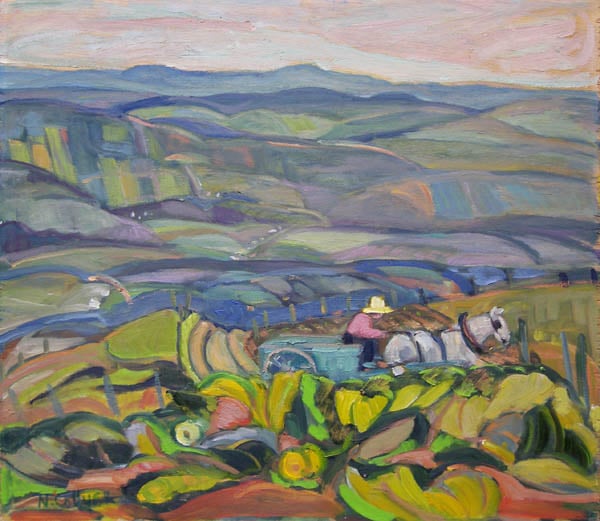
Beaver Hall Hill, painted 1935 by Kathleen Morris
An important group of early twentieth Canadian artists was largely forgotten until 1966 when the National Gallery of Canada mounted a traveling exhibition entitled The Beaver Hall Hill Group. In the 1960s, when feminism was growing in strength, the exhibit focused attention on a group of women artists who had formed an association in Montreal. The title of the exhibition was somewhat of a misnomer, as the Montreal group which formed in 1920 called themselves the “Beaver Hall Group”, (referring to the address of the their shared studio at 305 Beaver Hall Hill). The group, at its inception, included both men and women, most of whom had studied under William Brymner at the Art Association of Montreal,(now the Montreal Museum of Fine Arts).
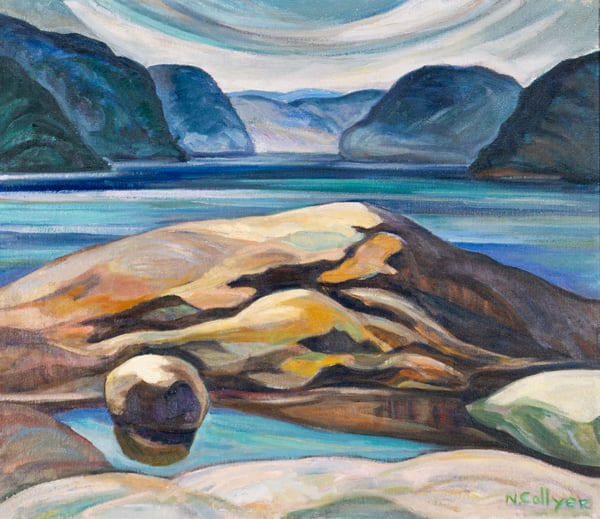
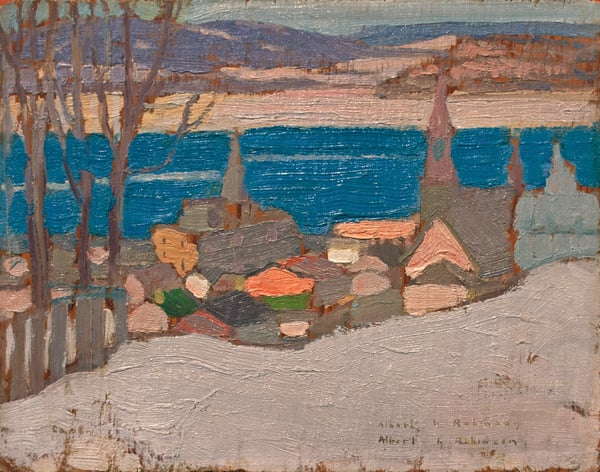
The notoriety of the all-male Group of Seven overshadowed the Montreal group in early art history books. There was, however, a connection between the famous Group of Seven and the lesser-known Beaver Hall Group. Montreal born, A.Y. Jackson was a member and voted President of the Beaver Hall Group. He, in turn invited Beaver Hall Group members to exhibit with the Group of Seven. The original Beaver Hall Group survived only two years, though some of them maintained studio space there until 1924. A nucleus of 6 women from the original group, Mabel May, Anne Savage, Mabel Lockerby, Sarah Robertson, Lilias Newton, and Nora Collyer were joined by Prudence Heward, Kathleen Morris and Ethel Seath to form a support network that lasted for over thirty years.
Art Assoc. Blg, Montreal
For the most part, in the early years of the Twentieth Century, women were excluded from participation in professional art academies and associations. The Art Association of Montreal, under the direction of William Brymer was one of the few art institutions which were open to female students. Classes began at the elementary level and continued to advanced courses in painting, drawing, portraiture and composition. William Brymner was president of the Royal Canadian Academy and maintained a very high standard of instruction, based on the art schools in Paris. Brymner was himself a graduate of the Académie Julian. It was his primary goal to prepare his students for a professional career in art. Unlike other distinguished art institutions of the time, women made up the majority of students at the Art Association of Montreal. This was because male students had many more options for study, and classes at the AAM were very expensive. The cost of tuition limited enrollment to the middle and upper classes. Highly motivated, but less wealthy students, such as Ethel Seath had to work in order to afford classes. While young men could further their art studies abroad or at other institutions, the professional art training of most female students began and ended at the AAM.

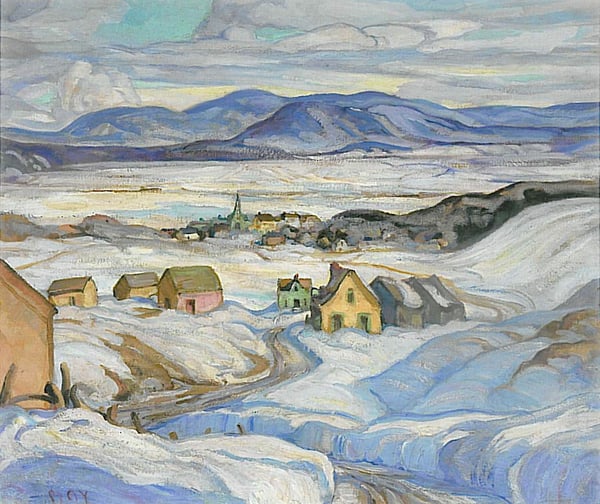
Beaver Hall Square, after a blizzard
Training at the Art Association of Montreal included landscape painting with the distinguished painter, Maurice Cullen. Cullen’s course of study included sketching trips into the countryside of rural Quebec each spring. Kathleen Morris, Prudence Heward and Ethel Seath, along with fellow students, Jack and Robert Pilot took part in these excursions. The habit of sketching together was a valuable experience which became a lifelong practice among the Beaver Hall women. The First World War interrupted studies and the female artists served in many ways. Mabel May participated in Lord Beaverbrook’s “Canada at War” program to commemorate Canada’s participation in the war effort. She received a commission to paint women working in a munitions factory. Prudence Heward and Lilias Newton traveled to England to serve with the Red Cross. Many were touched by the loss of close family members during the war years.
The important role that Canada played in the war effort had a profound effect on the Canadian psyche. Canadians began to view themselves as an independent nation, separate from Britain. This new nationalism had a profound influence on the direction of art in Canada. It was still a struggle, however, for Canadian artists to get their work represented in important commercial galleries, whose clientéle still viewed Canadian art as inferior. Female artists, in addition, had to deal with the prejudice of a conservative public, which continued to view women artists as dilettantes and hobbyists. In order to promote their work and develop new markets, artists felt the need to join forces in artist societies. The years following WWI saw the formation of two important art groups, the Group of Seven in Toronto and the Beaver Hall Group in Montreal.
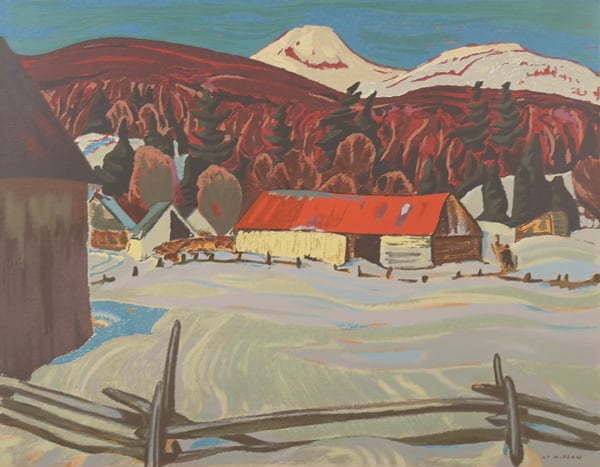
A.Y. Jackson, a founding member of the Group of Seven, was also a member of the Beaver Hall Group. Members of each group were invited to exhibit with the other. The house at 305 Beaver Hall Hill offered, much needed, inexpensive studio space. The founding members were Mabel May, Lilias Newton, Edwin Holgate, and Randolf Hewton, who then invited friends, Anne Savage and Mabel Lockerby to join. They held their first exhibition in 1921. Among those exhibiting with them were, Randolph Hewton, Edwin Holgate, A.Y. Jackson, Mabel Lockerby, Mabel May, Lilias Newton, H.R. Perrigard, Robert Pilot, Anne Savage and Adam Sheriff Scott. The exhibition prompted a reaction in the press. Jackson spoke at the exhibition’s opening, emphasizing that “Schools and ‘isms’ do not trouble us; individual expression is our chief concern”. Two years and four exhibitions later, the Beaver Hall Group disbanded, perhaps due to financial problems. The studio space was maintained for a further two years. During that time, it was frequented by women artists. Lilias Newton and Mabel May taught art classes for women on Saturday mornings. Emily Coonan rented a small studio there, and Nora Collyer shared studio space with Anne Savage. In that brief time, 305 Beaver Hall Hill was more that just a place to paint, it became a club, a friendly place to meet and discuss ideas. In 1924, when the artists could no longer afford the studio space, the remaining Beaver Hall women were Mabel May, Lilias Newton, Mabel Lockerby, Anne Savage, Sarah Robertson and Nora Collyer. They formed a network which expanded to include Prudence Heward, Kathleen Morris and Ethel Seath. The group continued without an official name. They maintained separate studios but kept in close contact, often traveling and painting together.
In 1933, several women of the Beaver Hall Group were instrumental in founding the Canadian Group of Painters. This new art society was created in response to the economic crisis of the Depression. It can also be considered an expansion of the Group of Seven. Among the founders were Prudence Heward, Sarah Robertson, Anne Savage, Mabel May and Lilias Newton. Lawren Harris was elected president, and A.Y. Jackson and Prudence Heward shared the post of Vice President. The new group continued to promote a Canadian nationalism in art. All the women of the Beaver Hall Group participated in the debut exhibition of the CGP at the Art Gallery of Toronto in 1933.
It was a struggle for a woman to be recognized as a serious artist at that time in history, so the CGP could not take the place of the Beaver Hall women’s own unofficial artist’s “society”. They continued to actively seek each others company and support. A.Y. Jackson recognized Sarah Robertson as the unofficial leader of the group. In 1928, he encouraged her to “Stir your gang on!” Among themselves, they called themselves simply, “our little group”. Jackson called them alternately the “Gang”, or the “Montreal Group”. However unofficial, the group had a cohesiveness that spanned decades. It was Norah McCullough, of the National Gallery of Canada, who designated them with the title of “Beaver Hall”, for the National Gallery of Canada’s traveling exhibition in 1966.
Biographical Reference:
A Dictionary of Canadian Artists – Volumes 1-7, by Colin s. MacDonald, Published by Canadian Paperbacks, Ottawa, 1967 – 1997 Painting Friends, The Beaver Hall Women Painters, by Barbara Meadowcroft, Véhiclue Press, Montreal, 1999
Bibliography:
Painting Friends: The Beaver Hall Women Painters, by Barbara Meadowcroft, published 1999 by Véhicule Press, Montreal
Suggested Reading:
Painting Friends, The Beaver Hall Women Painters, by Barbara Meadowcroft, Véhiclue Press, Montreal, 1999 The Women of Beaver Hall – Canadian
Modernist Painters, by Evelyn Walters, Dundurn Pres, Toronto, 2005